Skip to content
Portfolio Demo

One guided path through the project matrix.

The demo is not “look at several repos.” It is one operating story: I identify repeated workflow pain, build AI-native tools, publish the proof surface, and write the learning back into a compounding system.

Demo promise

From scattered repos to a visible operating system.

7

repos / surfaces unified into one demo path

4

repeatable loop stages from pain to write-back

1

central narrative: AI-native systems from real workflow pain

01Sense workflow pain

Find the repeated bottleneck

Start from real work: code review friction, manager-facing communication, knowledge retrieval, or AI tool routing.

02Build the tool

Turn the bottleneck into a system

Package the answer as a repo, skill, MCP server, proxy, site page, or repeatable knowledge workflow.

03Make it legible

Publish the proof surface

Expose the artifact through docs, visuals, live pages, demos, and writing so a stranger can understand it in minutes.

04Write learning back

Compound the next loop

Useful outputs become notes, code, pages, and reusable operating rules instead of disappearing into chat history.

Suggested 7-minute walkthrough

Use these seven stops to make the work instantly legible.

Each stop answers a different question an evaluator has: What is the thesis? What did you build? Can you reason deeply? Can you package workflows? Does it compound?

Editorial poster for the Digital Twin repo
01Operating layer

Digital Twin

A file-first operating layer that turns my knowledge base into a working digital twin for research, writing, site updates, and continuous refinement.

Demo line: Shows the central thesis: durable files + agent execution + write-back loops create a compounding personal OS.

MarkdownCodex SkillsObsidianKnowledge Systems

Show this

Open artifact

Use this as one stop in the story, not as an isolated repo tour.

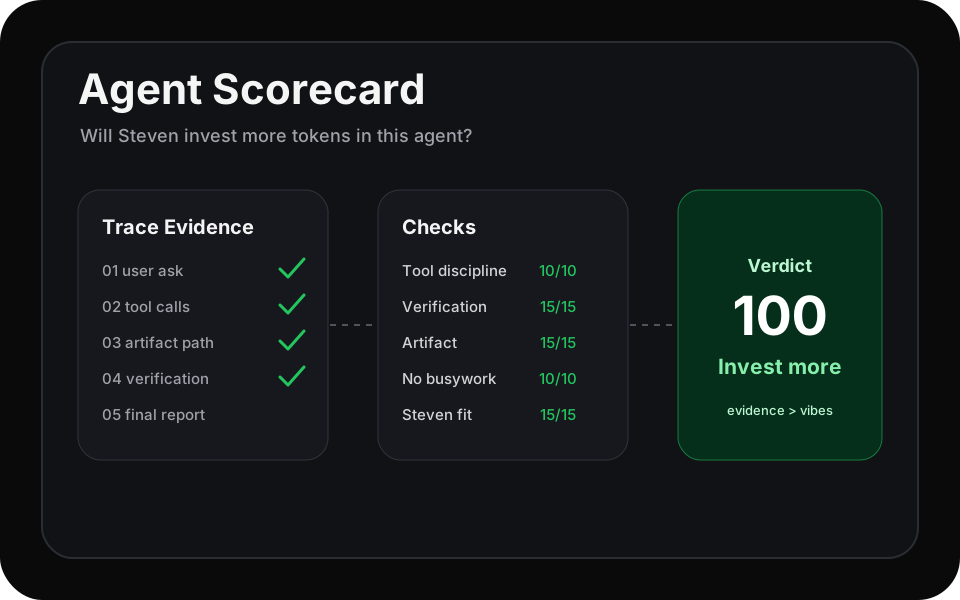
Agent Scorecard visual showing trace evidence, checks, and an invest-more verdict
02Evaluation layer

Agent Scorecard

A trace-first standard and CLI for judging whether an AI agent is worth more token budget, permissions, and autonomy in my real workflows.

Demo line: Turns agent usage from vibe-based token burning into a repeatable scorecard for artifacts, verification, busywork, and invest-more decisions.

PythonAgent EvalsJSONL TracesProof Chain

Show this

Open artifact

Use this as one stop in the story, not as an isolated repo tour.

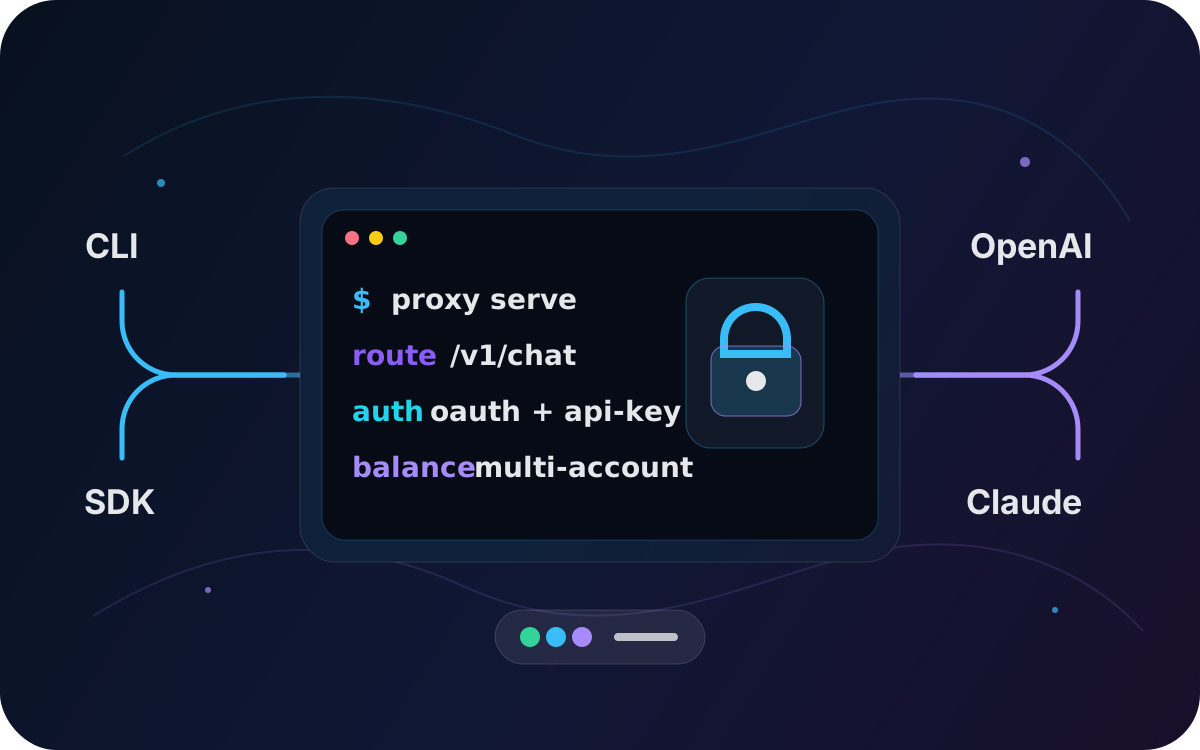
Terminal gateway visual for the CLIProxyAPI repo
03Model access layer

CLIProxyAPI

A proxy server that exposes OpenAI/Gemini/Claude/Codex-compatible APIs for CLI and coding tools, with OAuth login, provider routing, and multi-account load balancing.

Demo line: Turns fragmented CLI/OAuth/provider access into a routeable API surface for coding agents and workflows.

GoOAuthOpenAI-compatible APICLI Tools

Show this

Open artifact

Use this as one stop in the story, not as an isolated repo tour.

Blueprint-style cover for the Claude Code Sourcemap repo
04Research artifact

Claude Code Sourcemap

An 8-chapter interactive tutorial deconstructing Claude Code's internal architecture from its leaked source map. Bilingual (中文 / English), free and open-source.

Demo line: Converts source-code archaeology into a public, bilingual learning asset with diagrams and tutorials.

VitePressTypeScriptMermaidGitHub Pages

Show this

Open artifact

Use this as one stop in the story, not as an isolated repo tour.

High-contrast poster for the Manage Up repo
05Communication system

Manage Up

An anti-fluff workplace communication system packaged as both an MCP server and a reusable skill warehouse for manager-facing writing.

Demo line: Packages high-signal manager communication as reusable skills and an MCP-ready workflow.

MCPMarkdownShellAI Skills

Show this

Open artifact

Use this as one stop in the story, not as an isolated repo tour.

Knowledge Harness visual showing vault input, runtime query, and run outputs
06Runtime layer

Knowledge Harness

A quiet runtime layer for querying my Obsidian knowledge base, recording run artifacts, and turning digital-twin experiments into repeatable workflows.

Demo line: Connects Obsidian knowledge, run artifacts, and improvement proposals into a repeatable local execution layer.

PythonObsidianCodexKnowledge Systems

Show this

Open artifact

Use this as one stop in the story, not as an isolated repo tour.

Poster-style website cover for Steven Chou's personal site
07Public proof chain

Personal Website

My public narrative system: a Next.js site, MDX writing archive, and AI-assisted publishing workflow designed to compound proof over time.

Demo line: Acts as the canonical surface where the work is sequenced, explained, and made externally inspectable.

Next.jsReactTypeScriptTailwind CSSMDX

Show this

Open artifact

Use this as one stop in the story, not as an isolated repo tour.

Closing script

The through-line is leverage, not novelty.

The strongest read of this portfolio is that each project moves the same system forward: clearer access to models, clearer use of personal knowledge, clearer workplace communication, clearer public proof. The repos are not random side quests; they are modules in an AI-native operating layer.

Best next viewer action

If someone only has 90 seconds, send them here first. If they want the deeper thesis, route them to Digital Twin. If they want code proof, route them to CLIProxyAPI or Claude Code Sourcemap.